Looking back at EB Impact Day 2026: working together on societal impact
16 June 2026

The meeting focused on knowledge exchange, collaboration and EB’s impact ambitions. In total, 17 EB Impact Centres were represented, ranging from established centres to new and emerging EB impact initiatives.
Enduring ideas: what remains?
REC Impact Fellow Marco van der Werf opened the day with an inspiration session on enduring ideas. His central message: impact arises not only from what changes, but also from what remains.
Drawing on ideas and principles from major thinkers, Van der Werf showed how researchers and Impact Centres can engage in dialogue with external partners about the value of research and the university. In doing so, he invited the community to consider new ways of building relationships and collaborating. A good example is the new MBA Bookclub, which Van der Werf co-initiated with Armin Pircher Verdorfer from the renewed Amsterdam Center for Leadership and Purpose (ACLP).
From sharing knowledge to joining forces
The annual EB Impact Day shows that EB impact makers are not working in isolation. Sharing knowledge can lead to new collaborations and multidisciplinary impact research. One example is the collaboration between Corine Boon and Sander Klous. After meeting during last year’s edition, they joined forces across sections and centres. This resulted in securing funding to realise the ZODIAC project.
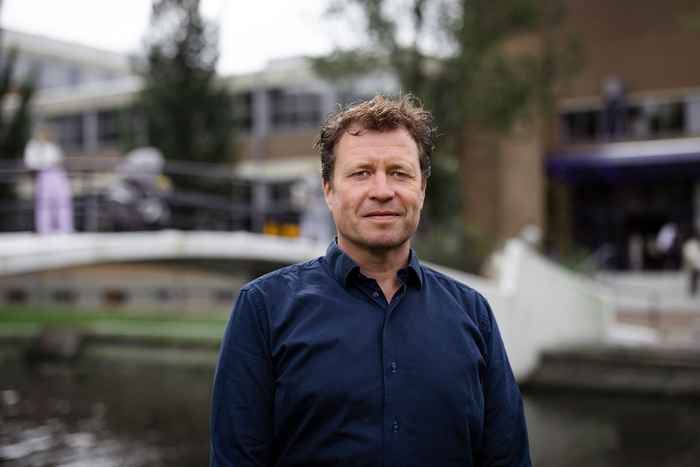
New Impact Centres introduce themselves
As last year, newly established Impact Centres presented themselves to their colleagues. Bas Kolen and Inez Zwetsloot from the new UvA EB Flood Insurance and Risk Management Lab (FIRM) explained how the centre managed to use a grant from the Top Consortium for Knowledge and Innovation. Within FIRM, water and finance come together. The centre connects a community of more than twenty knowledge partners from the insurance and water sectors and collaborates with SEVEN, UvA’s climate institute.
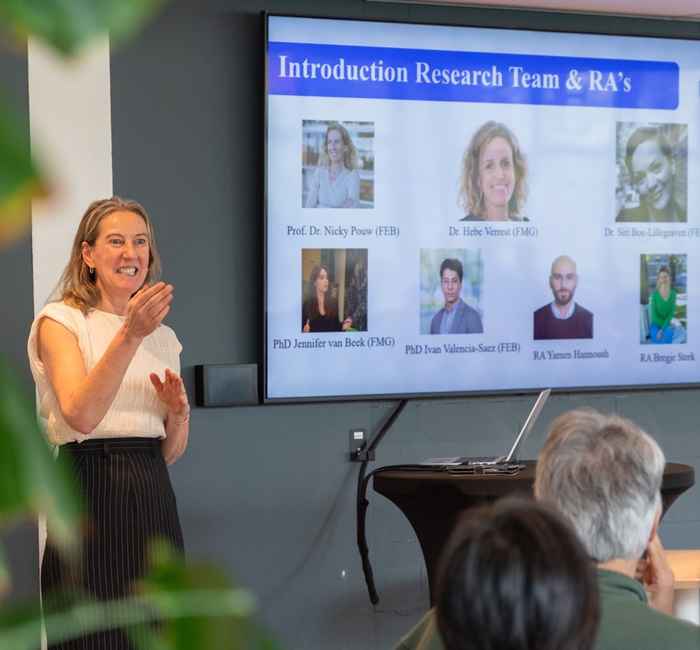
Nicky Pouw, director of the Amsterdam Social and Economic Wellbeing Research Centre (ASEWeBE), showed how long-term collaboration with municipalities can lead to a new centre focused on wellbeing economics. From an interdisciplinary academic perspective, ASEWeBE contributes to a new economic paradigm centred on human wellbeing. The centre also translates knowledge into practical policy instruments, such as wellbeing dashboards developed in co-creation with local neighbourhood communities.
Impact through long-term collaboration
During the EB Impact Day, the leads of the Impact Centres discussed their progress. They openly shared the challenges and breakthroughs they have encountered along the way.
An important insight was the high value of long-term collaboration with external partners. These relationships go beyond stand-alone projects. Some Impact Centres, for example, see that partners provide access to longitudinal datasets. In collaboration with researchers, these datasets can be further developed and used for socially relevant research.
The consensus was that societal impact in the social sciences often develops step by step. Trust and relationships lead to joint projects, which can grow into long-term partnerships. There are opportunities in further expanding relationships that arise from challenge-based teaching projects. Faculty procedures and engagement support can be better aligned with this dynamic.
The future of EB’s impact profile
EB is currently renewing its faculty strategy. Internal strategy sessions are taking place for this purpose. These conversations show that impact is now an established pillar for collaborative research and teaching. Impact is also becoming increasingly intertwined with both research and education.
During the EB Impact Day, participants provided valuable input for updating EB’s impact strategy. An important insight was that alumni and REC Impact Fellows form a valuable network that EB can involve more systematically in impact activities.
To better support these networks, EB aims to connect the Impact Centres and colleagues involved in impact in thematic Chapters. These Chapters will align more closely with the broader UvA Impact Priority themes. Communication also emerged as an important point of attention. The new EB Impact website brings impact projects and success stories together in one place. By clustering projects more strongly around themes, EB can communicate more effectively and reach the right audiences more easily.
Get involved
Are you curious how your research can create more societal value? Or do you have ideas or questions about collaborating with an Impact Centre? Contact the EB Impact Office or reach out directly to one of the Impact Centres.