UvA ZODIAC project awarded KHMW Stimulus
17 March 2026
The interdisciplinary research will be conducted by UvA Economics and Business, the Faculty of Science and the Amsterdam Law School. The award, presented for the first time in 2026, includes €400,000 in funding and is supported by the Stichting De Quay Rutten. The UvA’s proposal was selected from 87 submissions from universities across the Netherlands.
The research team
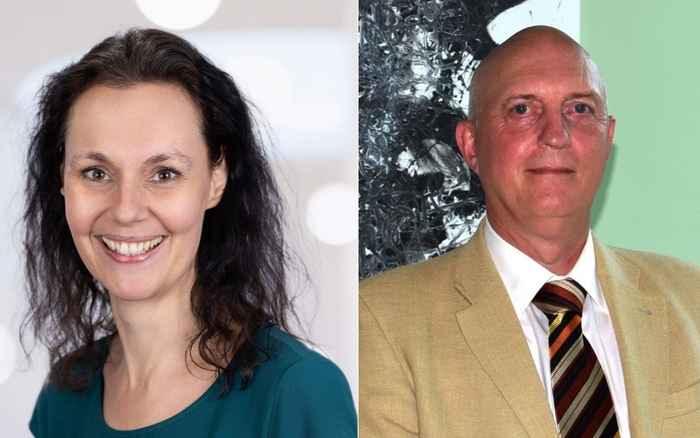
ZODIAC (Zero-person Organisational Departments in Interaction, Accountability and Collaboration) is led by Corine Boon, Professor of HRM & People Analytics at the Amsterdam Business School, and Tom van Engers, Professor of Legal Knowledge Management at Amsterdam Law School. Other members of the team include Economics and Business researchers include Almasa Sabari, Neris Güven and Marco Rapp, and Faculty of Science researchers professor Sander Klous and Thomas van Binsbergen.
Opportunities and risks
The researchers believe organisations are approaching a turning point where large parts of organisations may be run by relatively autonomous agent-based systems. It is not a question of if this will happen, but when.
The project looks beyond automating individual tasks and instead studies what happens when entire departments are run by AI systems. In such departments, AI takes on decision-making, communication with employees, and collaboration with other units.
This shift could bring clear advantages. Automating routine processes can improve efficiency, reduce workload, and increase productivity. This is because AI systems can operate continuously and potentially lower operational costs.
At the same time, the team highlights important challenges. Working alongside AI instead of human colleagues may change team dynamics and how people experience their jobs. Roles are likely to shift towards monitoring and evaluating AI output, requiring new skills. There is also a risk that certain expertise may decline if it is used less frequently. In addition, entry-level roles that are often essential for gaining experience could become less common.
ZODIAC aims to improve the understanding how zero-person departments will work in practice. Despite the increasing autonomy of such systems, responsibility remains with humans. There are ethical, legal and societal considerations that still need to be explored.
Human–AI collaboration in practice
The research is carried out in close collaboration with partners including KPMG and the shared services centre of the Dutch Ministry of the Interior and Kingdom Relations.
Key questions include how people collaborate with fully automated departments, how roles and skills evolve, and what the impact is on workload, wellbeing and oversight. The project also examines long-term effects on organisational performance and accountability. The findings are expected to offer practical guidance for organisations that want to adopt AI responsibly. The funding will support the appointment of 2 researchers.
Symposium on AI and the future of work
The award ceremony will take place on Friday 5 June. Ahead of the ceremony, KHMW will host a symposium on the impact of AI on work and organisations.
Speakers include:
- Sander Klous, professor of AI & Audit at the University of Amsterdam and Partner Data & Analytics at KPMG
- Anna Salomons, Professor of Automation in the Labour Market at Tilburg University and Professor of Employment & Inequality at Utrecht University
- Mark van Vugt, Professor of Evolutionary and Work and Organisational Psychology at Vrije Universiteit Amsterdam and the University of Oxford
During the event, the ZODIAC team will present their research and reflect on the implications of AI-driven organisational change.