New research initiative maps flood risks and their consequences for the financial sector
Amsterdam School of Economics and Nationale-Nederlanden bring water and finance together
9 September 2026
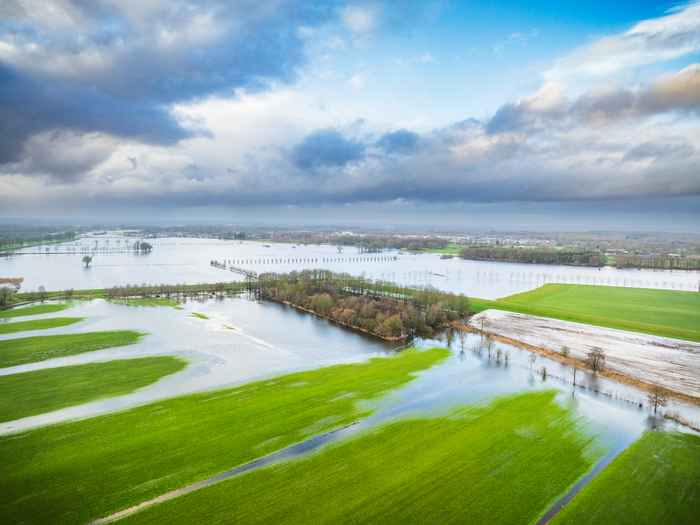
Climate change and climate adaptation affect the financial world too, because risks are increasing. Sound, realistic risk models are indispensable if insurers are to assess flood risks accurately and contribute to effective and affordable climate adaptation. The floods in Limburg (Belgium and Germany) caused by extreme rainfall in 2021 made clear that genuinely extreme events really can occur. The Delta Programme Commissioner is likewise calling for greater investment in water management.
Rainfall is not the only source of damage. Flooding caused by dyke breaches leads to far greater damage still. A key question is how many homes and businesses are affected simultaneously, now and in the future, when dykes breach or extreme rainfall occurs, how likely such events are, and how much damage they cause.
We must guard against overestimating the risk
'When it comes to estimating the risk of large-scale flooding after a dyke breach, the data you use and the way you combine it matter a great deal,' says FIRM director Bas Kolen, Professor by Special Appointment in Enterprise Risk Management at the University of Amsterdam and scientific director of the consultancy HKV lijn in water. 'On the basis of publicly available maps and estimates, the flood risk from dyke breaches in the Netherlands can be overestimated by as much as a factor of ten, chiefly because the probability itself is set too high. As a result, we overestimate the risks and the correlations — the chance that several buildings are flooded at the same time. That in turn can lead to premiums and interest rate surcharges that are too high. You cannot simply add everything together; you have to allow for correlations and add up the risks and probabilities of the individual scenarios.'
'There will always be uncertainty,' Kolen stresses. 'We are talking about rare, extreme events that have not yet occurred in this form. But by taking better account of the interplay between dyke breaches, emergency measures and the real strength of flood defences, we arrive at a more realistic picture.' FIRM wants to help the financial sector calculate these risks more accurately, so that premiums, capital buffers and investments match the actual risk — neither unnecessarily high nor too low.
From neighbourhood to region
Important questions also remain about flooding caused by extreme rainfall. Kolen: 'With extreme rainfall, we have a reasonably good idea of how likely it is that a given amount of rain will fall in a single location. What we know far less well is how large the area is over which that downpour falls and causes damage. Does the same amount of rain fall on one neighbourhood, or across an entire region? That spatial extent partly determines how much damage may arise in an average or an extreme year — and it is therefore crucial to estimating the financial risk properly.
'There is also a good deal of debate about how much damage rainfall actually causes at present. There are indications that we underestimate this damage to buildings. That knowledge matters if we are also to explore the scope for rebuilding more intelligently.' FIRM's researchers will therefore also be gathering new damage data, so that the consequences of different forms of rainfall-related flooding can be assessed more precisely.
Tjeerd Bosklopper, CEO Netherlands Non-life, Banking & Technology and member of the Management Board of NN Group: 'With climate change, we can no longer rely on historical data alone. If we want to keep the Netherlands and Europe insurable, we will need to invest together, across a range of forums, in looking ahead, in prevention and in cross-border cooperation.'
Effects on the wider economy
Besides developing better models, Kolen and his FIRM colleagues are examining how climate adaptation may work through into the economy. What do choices between different long-term strategic directions — such as those set out in the Sea Level Rise Knowledge Programme, ranging from continued protection and spatial planning through to retreat — mean for the earning capacity of the Netherlands, by way of the financial consequences for insurance and investment? Under which climate conditions will the financial sector genuinely start to influence spatial planning and economic development? As part of this, FIRM is investigating the role insurers can play in preventing and limiting damage, for example through warnings and by taking a smarter approach to repair after damage occurs (building back better). Reliable risk information contributes to financial stability, the investment climate and the creditworthiness of the Netherlands.
About FIRM
FIRM is a joint initiative of the Amsterdam School of Economics at the University of Amsterdam and Nationale-Nederlanden. The research is made possible in part by a grant from TKI (Top Consortium for Knowledge and Innovation) Delta Technology. FIRM also includes partners from the financial sector, the water sector and government:
- Financial sector: ING, Achmea, a.s.r., Zurich and Aon
- Water sector: HKV, Witteveen+Bos and Deltares
- Impact partners: the Ministry of Infrastructure and Water Management, the Dutch Association of Insurers, STOWA, VNAB, NL AAA-Klimaatbestendig and DigiShape
The partners each contribute their own expertise to research that addresses questions of societal and professional relevance. FIRM's research findings will be made publicly available to the wider financial and insurance sector.