Actuary of the Year Michel Vellekoop: ‘Keep thinking for yourself in the age of AI’
30 September 2026
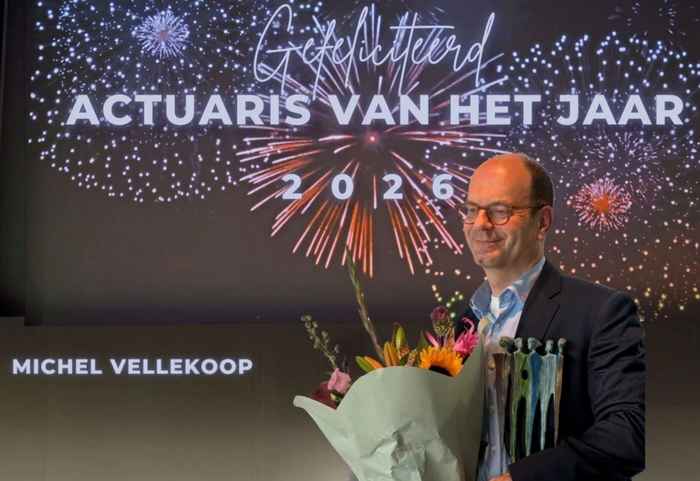
This is according to Michel Vellekoop, Professor of Actuarial Science & Mathematical Finance at the Amsterdam School of Economics (ASE). He was named Actuary of the Year 2026 during the Day of the Actuary in Zeist.
Opportunities and critical questions
AI and data science are rapidly changing the actuarial profession. Models can process large volumes of data, identify complex patterns and automate tasks that previously required considerable time and specialist knowledge. Vellekoop sees this primarily as an opportunity. With their expertise in statistics, modelling and risk, actuaries are well placed to use these technologies responsibly.
However, greater computing power and more complex models do not automatically lead to better decisions. According to Vellekoop, the central question is therefore not only which tasks AI can take over, but also where the added value of the actuary will lie.
Understanding what a model does
This question is also relevant in education. Students can now use AI tools to obtain answers to complex problems within seconds. Vellekoop warns against confusing the ability to formulate prompts with substantive knowledge. Those who simply adopt an AI-generated answer without being able to assess it lose their added value.
Actuaries of the future will not need to calculate everything themselves. But they will need to understand what a model calculates, why it does so and when its outcomes can be used. Subject expertise, the ability to distinguish between main and secondary issues, clear communication and professional judgement will therefore become increasingly important.
Technology and ethics
Ethics will also play a greater role in the profession. AI and larger datasets make it possible, for example, to determine insurance risks with increasing precision for individual people. Data from smartwatches could be used to set premiums. This raises questions about privacy, solidarity and the limits of individual risk pricing.
According to Vellekoop, it is not necessarily up to actuaries to determine where those limits lie. However, they do have a responsibility to explain clearly to policymakers what is technically possible and what the consequences of particular choices may be.
Recognition for research and education
The jury praised Vellekoop for his ability to connect research, education and actuarial practice. He was among the founders of the Research Centre for Longevity Risk, which the UvA established with Nationale-Nederlanden.
ASE researcher Jens Robben was also 1 of 3 nominees for Actuarial Talent of the Year.