RCLR helps map stark mortality inequalities in Scotland
8 April 2026
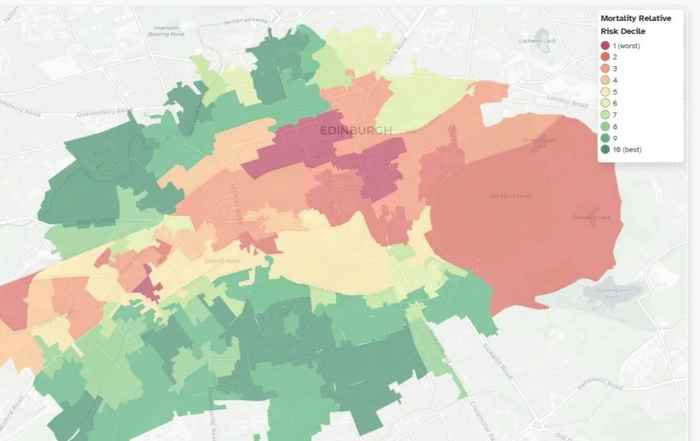
The Index of Scottish Life Expectancy (THISLE) shows life expectancy differences of up to 20 years between areas. The project is a collaboration between Heriot-Watt’s School of Mathematical and Computer Sciences, RCLR at the University of Amsterdam and Heriot-Watt’s Mathematical-Driven Innovation Centre (M-DICE). The online tool is publicly available.
Using advanced statistical modelling and 2024 mortality data from the National Records of Scotland, THISLE provides highly localised estimates for all 6,976 Scottish Data Zones (around 800 residents each). It reports mortality risk relative to the national average by sex, age and year, and gives life expectancy estimates for men and women at different ages.
The results show that 18% of neighbourhoods have mortality rates less than half the national average, while 8% have more than double the national average. Among men aged 40 to 59, the highest-risk 1% of areas have mortality rates 12 times higher than the lowest-risk 1%. The tool also confirms known factors such as unemployment and education and highlights others, such as the role of marriage.
Broader application
For policymakers, health services and local organisations, THISLE offers more precise and localised insights than existing tools such as the Scottish Index of Multiple Deprivation. By presenting sex- and age-specific data at true neighbourhood scale, the tool can support more targeted interventions and a deeper understanding of the social factors underpinning health inequalities.
RCLR and UvA researchers will continue to work with partners at Heriot-Watt University and M-DICE to refine the models and explore how similar approaches can be applied in other countries and contexts.