Amsterdam Social and Economic Wellbeing Research Centre
This broader approach is necessary. Economic growth does not automatically lead to better opportunities for everyone. Growing numbers of people are experiencing pressure on their disposable income and on their access to housing, healthcare, education, healthy food and other essential services.
ASEWeBe’s mission is to connect fundamental insight into human needs with policy-relevant research. Through this approach, the centre contributes to a wellbeing economy in which livelihood security is seen as a condition for stable economic behaviour.
ASEWeBe connects academic research with urban issues relating to livelihood security and wellbeing. Researchers collaborate with residents, civil society organisations and policymakers. The centre combines insights from economics, behavioural science, public administration and socio-spatial research.
ASEWeBe works towards three objectives:
- strengthening fundamental research into the wellbeing economy, basic human needs and livelihood security thresholds;
- translating knowledge into practical tools, such as wellbeing dashboards, indicator sets and impact measurements;
- training new researchers and professionals through education, Community Service Learning and training for PhD candidates and postdocs.
Research programmes
ASEWeBe works with 3 interconnected research lines.
1. Fundamental wellbeing theory and measurement
This research line develops theoretical frameworks and empirical measurement methods for primary needs. Particular attention is paid to livelihood security, disposable income, access to essential services and social relations. ASEWeBe examines how these factors together determine whether people are able to act economically.
2. Applied dashboards and indicator development
This research line translates academic insights into measurable tools. Examples include wellbeing dashboards that have been developed from the bottom up and tested in urban neighbourhoods, including Amsterdam Zuidoost and Nieuw-West. The dashboards and indicators are intended for use in different social and economic contexts. They can be scaled up to other neighbourhoods, cities and regions.
3. Governance, behavioural science and social embedding
This research line examines which institutional conditions, policy effects and behavioural dynamics play a role when livelihood security comes under pressure. ASEWeBe also looks at how research can be embedded sustainably in policy, organisations and communities.
About the Wellbeing Dashboard
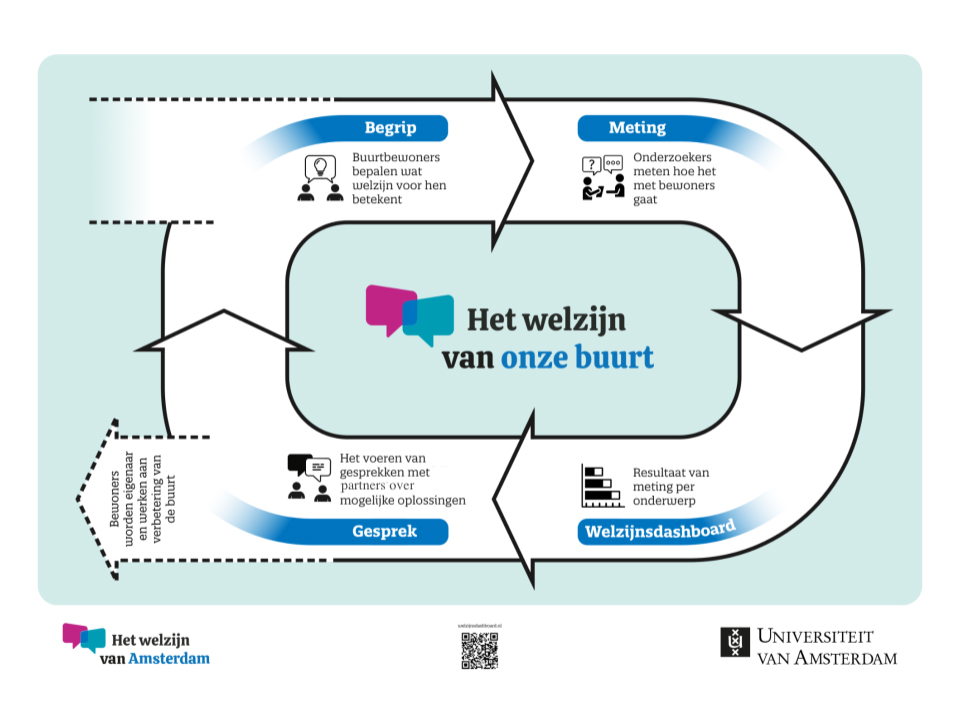
The Wellbeing Dashboard provides insight into wellbeing and livelihood security at neighbourhood level. It shows where inequality emerges, what causes lie behind it and where there are opportunities to improve the living environment. In this way, the dashboard offers not only insight but also scope for action.
Residents play a central role in the development of the dashboard. Through co-creation, they determine which dimensions of wellbeing and which indicators are important for their neighbourhood. As a result, the dashboard reflects local experiences and needs. It also functions as a democratic tool: residents themselves map out what they need in order to strengthen their wellbeing.
Residents are encouraged to take ownership of the dashboard and the associated dialogue sessions. This creates a more equal form of collaboration between residents, the municipality and other partners.
ASEWeBe supports the sustainable safeguarding of the dashboards. Together with partners, the centre updates, adapts and further develops the dashboards, ensuring that they remain relevant in a changing urban context.
As a measurement tool, the Wellbeing Dashboard makes multidimensional wellbeing and threshold values in livelihood security visible.
Organisation and team
ASEWeBe is embedded within the Amsterdam School of Economics of the Faculty of Economics and Business at the University of Amsterdam. The centre is affiliated with the Macro & International Economics section and forms the research environment for the Chair in Economics of Wellbeing. The chair is made possible by the Nationaal Programma Samen Nieuw-West and the Masterplan Zuidoost. As an interfaculty platform, ASEWeBe connects UvA Economics and Business with the Faculty of Social and Behavioural Sciences.
Nicky Pouw is scientific director of ASEWeBe. She holds the Chair in Economics of Wellbeing at UvA Economics and Business. Contact: n.r.m.pouw@uva.nl.
Hebe Verrest is general director of ASEWeBe. She is Associate Professor of International Development Studies and Human Geography at the Faculty of Social and Behavioural Sciences of the University of Amsterdam. Contact: h.j.l.m.verrest@uva.nl.
Najah Aouaki is ecosystem director of ASEWeBe. She connects academia, policy, practice and communities, and works on partner development and societal impact. Contact: najah@aouakiconcepts.nl.
Affiliated researchers
- Dr Siri Boe-Lillegraven, UvA Economics and Business
- Jennifer van Beek, postdoc, UvA Social and Behavioural Sciences
- Ivan Valencia-Saez, PhD candidate, UvA Economics and Business
Advisory Board
- Lydia Pont
- Sebastiaan van de Kasteele
Publications
Pouw, N. R. M. (2020). Wellbeing economics: How and why economics needs to change. Amsterdam University Press.
Pouw, N. R. M. (2020). Welzijnseconomie: Hoe en waarom de economie moet veranderen. Amsterdam University Press. (Dutch edition).
Pouw, N. R. M., Verrest, H. J. L. M., & van Beek, J. E. M. (2021). Welzijnsindex voor de Stad Amsterdam: Verkennende studie. Gemeente Amsterdam.
van Beek, J. E. M., Pouw, N. R. M., & Verrest, H. J. L. M. (2026). Co-creation to measure what matters: The case of Venserpolder, Amsterdam. Journal of Urban Affairs, 48(5), 1544–1563.
Jennifer E. M. van Beek. (2026). Measuring what matters: A Wellbeing Economics approach to urban marginality in high-income contexts (Doctoral dissertation). University of Amsterdam.
Verrest, H. J. L. M., & Pouw, N. R. M. (2025). Just inclusion through bottom-up wellbeing measurement: Case study in Venserpolder, Amsterdam. Progress in Development Studies, 25(3–4), 175–193.
van Hoften, F., Pouw, N. R. M., & Rammelt, C. (2026). Bridging beyond GDP and degrowth: Identifying measurements that are fit for future. Ecological Economics, 244, Article 108945.