ASE economist wins award for best PhD thesis
16 December 2025
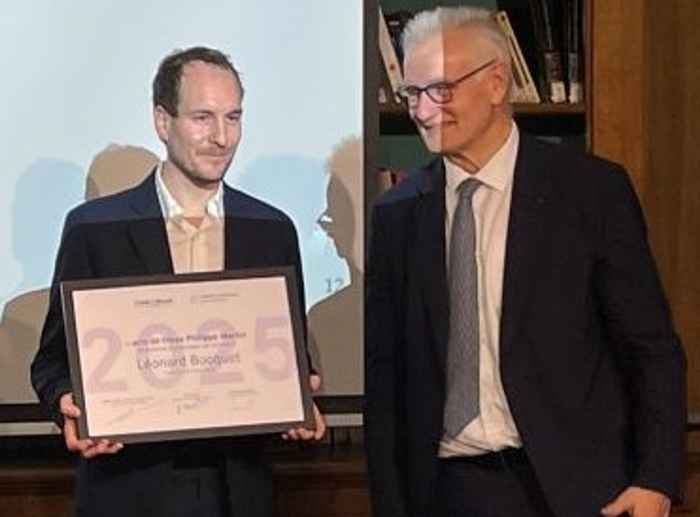
The award was presented by Sciences Po and the CEPR – Centre for Economic Policy Research. The prize, supported by the Conseil d’analyse économique (CAE) and Crédit Mutuel, recognizes the work of outstanding young researchers in economics.
Why labour markets adjust slowly
In the award-winning job market paper, The Network Origin of Slow Labor Reallocation, Bocquet asks a central question: how fast do labour markets adjust to technological change? By combining network theory with labour economics, he shows how so-called skill frictions slow down the movement of workers between jobs. His model places job search within a network of occupations and highlights the outsized role of a small number of ‘bridge occupations’. These roles connect different parts of the labour market and can either speed up or block transitions. The model predicts that major technology shocks, such as the adoption of robots, can lead to very gradual labour reallocation. In some cases, adjustment takes around 10 years, with clear consequences for workers and policymakers alike.
Research with societal relevance
Bocquet completed his PhD at the Paris School of Economics. Before joining ASE's Macro & International Economics section, he held research positions at the University of Cambridge and at the London School of Economics and Political Science (LSE). His work helps explain why technological change often leads to prolonged disruption in labour markets. By identifying where the bottlenecks are, his research offers valuable insights for education, training and labour market policy.